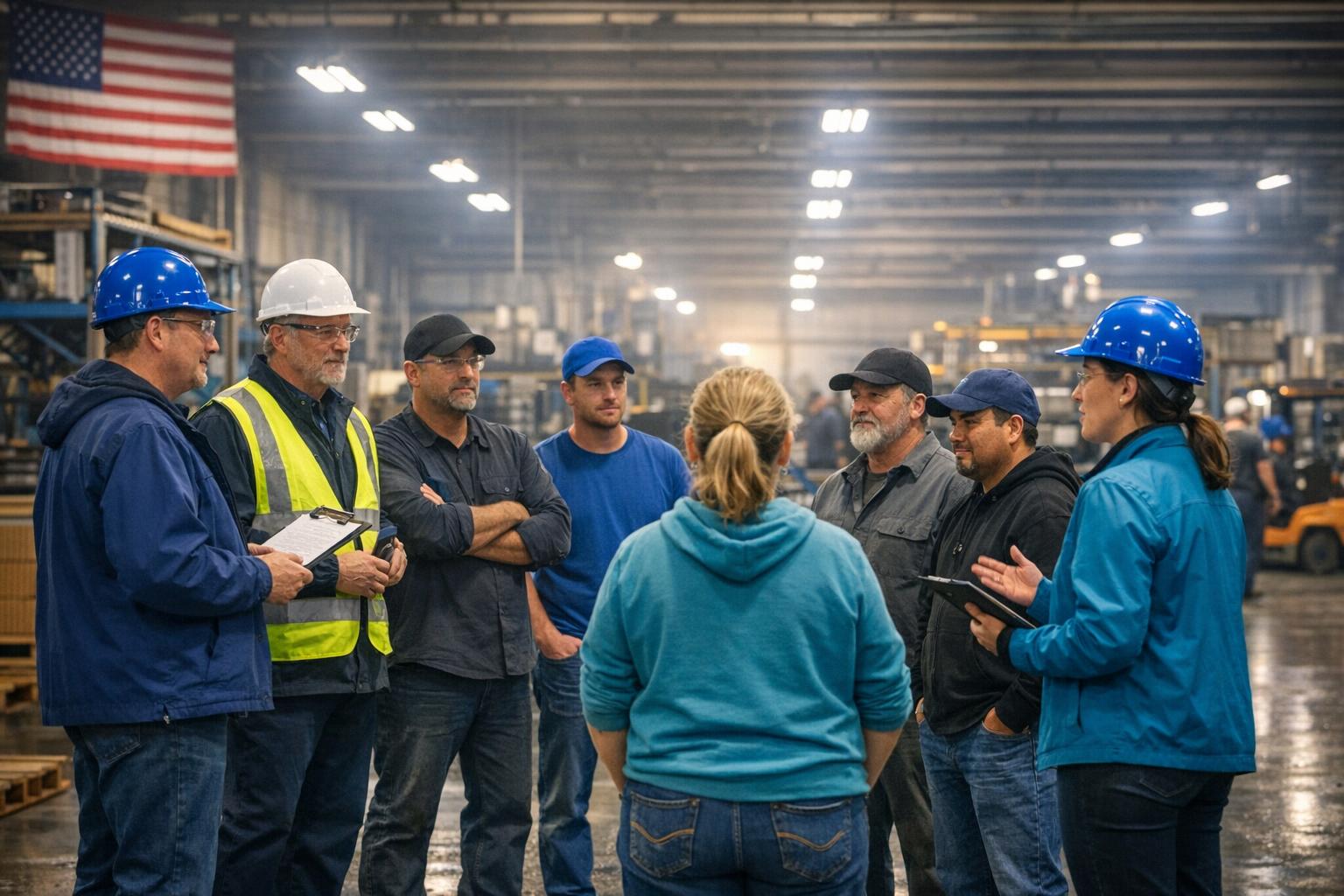
Kansas plants need coverage plans that match a tighter labor market
For Kansas manufacturers, shift coverage is not just a scheduling issue. It is an operating risk that can affect output, safety and customer commitments when absences hit critical lines or skilled roles. Statewide manufacturing employment reached 173,300 in July 2026, while Kansas posted a 3.8% seasonally adjusted unemployment rate. Those figures do not prove a manufacturing-specific shortage, but they do point to a relatively constrained labor pool for replacing absent workers quickly or scaling up coverage on short notice.
That is why many employers are rethinking how they use temporary manufacturing staff. In practice, the strongest case is not to treat temporary help as a permanent substitute for workforce planning. It is to use it as one part of a plant-specific coverage model that accounts for absences, training time, turnover and the reality that specialized jobs are harder to backfill than general labor positions.
Overtime is already doing part of the work
National hours data show that manufacturers are already leaning on overtime to maintain coverage. In August 2026, manufacturing employees averaged 40.5 hours per week, including 3.1 overtime hours. Production and nonsupervisory employees in manufacturing averaged 4.0 overtime hours in the same month.
That matters for Kansas employers because overtime is clearly functioning as a capacity buffer across the industry. It can help absorb short-term fluctuations in demand, vacancies or call-offs. But the data do not show why each plant scheduled overtime, so employers should be careful not to assume every extra hour reflects labor scarcity alone.
Longer-term figures tell a similar story. BLS reported that average overtime in nondurable-goods manufacturing was 3.8 hours per week in 2025, with variation across detailed industries. For operations leaders, the takeaway is straightforward: overtime is normal in manufacturing, but it should support a staffing plan, not replace one.
Absences are predictable at the industry level, disruptive at the plant level
BLS data show that full-time manufacturing wage-and-salary workers had a 2.9% absence rate in 2025. Of that total, 2.2% was tied to illness or injury and 0.8% to other reasons. BLS counts an absence when someone who usually works at least 35 hours per week works fewer than 35 hours during the reference week for reasons such as illness, injury or personal obligations.
That national benchmark is useful, but it is not the same as a shift-by-shift call-off rate inside a Kansas plant. A facility with thin relief coverage can feel much more disruption than the annual average suggests, especially on nights, weekends or in jobs that require certifications, machine familiarity or line-specific training.
This is where temporary manufacturing staff can be operationally valuable. When employers use them to cover known pressure points, protect trained core employees from repeated unscheduled extensions and maintain continuity in support roles, they can reduce the odds that one absence turns into a missed production target.
Night shifts and long hours raise the cost of weak coverage
Coverage decisions are not only about filling a slot. They also shape fatigue risk.
For employers trying to close gaps by repeatedly extending incumbent employees, those numbers are a warning. The short-term convenience of pushing coverage through overtime can come with higher odds of errors, incidents and lost-time consequences.
The practical implication is to use overtime selectively, preserve enough rest between shifts and build a trained bench for critical functions. Temporary manufacturing staff are most useful when they help operations avoid stacking fatigue onto already demanding schedules.
The best coverage model separates planned capacity from emergency replacement
National hiring data underline how difficult it can be to rely on last-minute recruiting alone. In July 2026, manufacturing recorded 580,000 job openings, 288,000 hires and 286,000 total separations nationwide. That combination suggests an industry that is still hiring, still turning over and not positioned for effortless replacement of absent workers.
For Kansas manufacturers, a better approach is to separate planned capacity from emergency coverage. Planned capacity includes the headcount needed to run lines, meet service levels and handle ordinary demand. Emergency coverage includes the relief factor for absences, training time, vacations, turnover and safety-related restrictions. When employers blend those categories together, overtime tends to become a default answer.
A more resilient model is to calculate coverage by shift, department and skill, then decide where temporary manufacturing staff can stabilize operations fastest. That may mean protecting second and third shifts, supporting maintenance windows, or filling feeder roles so experienced operators stay on their highest-value work.
Manufacturing shift coverage works best when employers treat overtime as a controlled buffer and temporary manufacturing staff as a targeted support tool. In a Kansas labor market with limited slack, the plants that avoid production disruption are usually the ones that plan relief coverage by skill and shift before the call-offs start.
Sources
- Table A. Job openings, hires, and total separations by industry ... 2026-09-01
- JOLTS Home : U.S. Bureau of Labor Statistics 2022-11-04
- Overtime hours in manufacturing industries - Bureau of Labor Statistics 2026-03-31
- Table B-2. Average weekly hours and overtime of all employees on ... 2026-09-04
- Table B-7. Average weekly hours and overtime of production and ... 2026-09-04